Making choices
The perils of fill-in-the-blank territory

Isaac started college this month. (In the U.K., “college” refers to the last two years of secondary school, while in America, “university” and “college” are used more or less interchangeably.)
Not only does this end the era of highly structured learning, five days a week, it means that he has to get to and from college on his own. No more transport service. No after school clubs. And no class on Wednesdays at all.
I give a lot of credit to the local council for preparing him for this day. As part of his secondary schooling, Isaac had a dedicated “travel trainer” who familiarised him with the local bus routes and gamed out edge-case scenarios, such as missing his stop or getting on the wrong bus.
He’s attending an inclusive program within a mainstream college that’s less than a mile from our home. He experienced the same academic rites of passages that all students did, taking a combination of GCSEs and Entry Level exams, which not only give a snapshot of their academic capabilities, but make them feel more in tune with typically developing kids.
He’s now a big man on campus.
But being a big man—or at least, his own man—has responsibilities.
Suddenly, he has so many decisions to make. What time do I need to leave? Do I cross at this crosswalk or one further down? Do I risk my parent’s wrath by taking public transport instead of walking? Do I take the shortcut through the cemetery? What should I eat for lunch?
He’s moved from multiple choice to fill-in-the-blank territory, with all its terrifying unbounded consequences. Terrifying for me, that is.
Until I thought it about it some more. If the primary job of a parent is to teach their kids how to make good decisions (which I think it is), then college is a chance to see how we’ve done.
So. Deep breath. Here’s his first lunch choice:
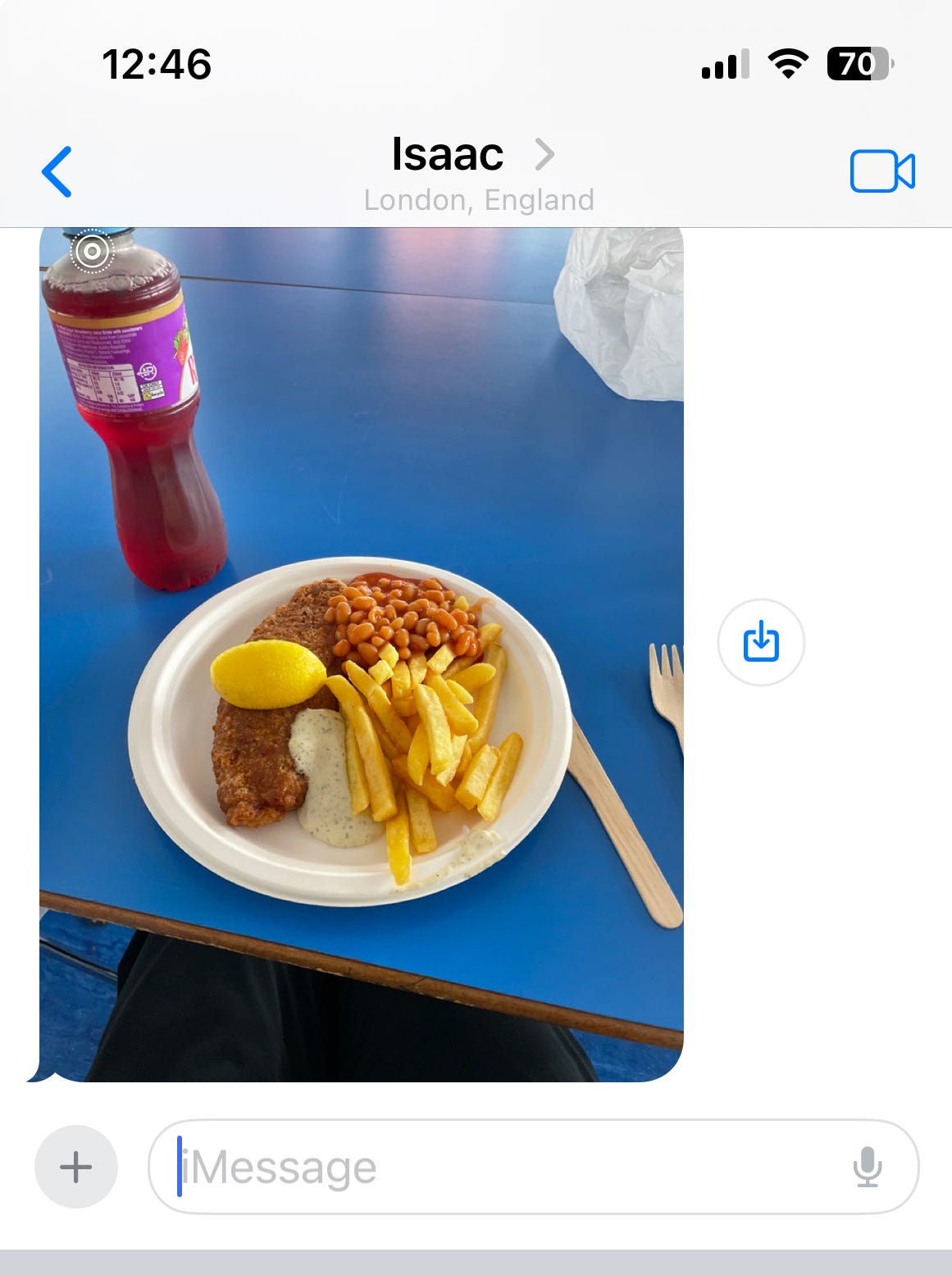
He’s going to be just fine.